12 AI Prompt Frameworks That Will Transform the Way You Use AI: The Complete Guide to Getting 10x Better Results
Most people type a single lazy sentence into ChatGPT, get a mediocre answer, and conclude that AI is overhyped. The truth? The AI isn't broken — your prompt is. The difference between a useless AI response and a jaw-dropping one comes down to one thing: structure.
Professional prompt engineers, marketers, and developers have been quietly using proven prompt frameworks to extract dramatically better results from every AI tool — from ChatGPT and Claude to Gemini and Copilot. These aren't hacks or tricks. They're systematic approaches to communicating with AI that consistently produce superior outputs.
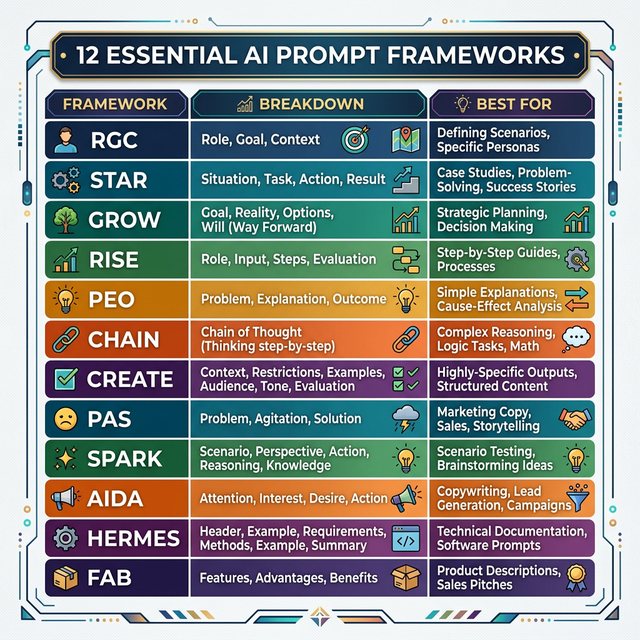
In this comprehensive guide, you'll discover 12 battle-tested AI prompt frameworks, each designed for different situations. Whether you need a quick social media post or a full marketing campaign strategy, there's a framework here that will get you there — faster, better, and without the frustrating back-and-forth.
Why Prompt Frameworks Matter
Before diving into the frameworks, let's understand the fundamental problem. When you type a vague prompt like "write me an ad", the AI has to make dozens of assumptions: Who are you? What's the product? What tone? What length? What format? What platform?
Every assumption is a chance to get it wrong.
Prompt frameworks eliminate assumptions by giving AI exactly what it needs to produce the output you want. Think of them as templates that force clarity — for both you and the AI.
Here are the key benefits:
- Consistency — Get reliable results every time, not random quality
- Speed — Spend 2 minutes on a structured prompt instead of 20 minutes editing a bad response
- Precision — Get exactly what you need without multiple rounds of revision
- Expertise — Make AI think like a specialist, not a generic assistant
1. RTF Framework — Role · Task · Format
Best for: Quick content creation and everyday prompts
The RTF framework is the simplest and fastest approach. Three parts. Works every time. If you only learn one framework, make it this one.
The 3 Components
- Role → Tell AI who to be (the expert persona)
- Task → Tell AI what to do (the specific job)
- Format → Tell AI how to present it (the output structure)
Why It Works
When AI has a role, it thinks from that expert's perspective. A "Facebook Ads expert" will write differently than a "creative writing professor." Better role = better answer.
Real Example
Role: "Act as a Facebook Ads expert with 10 years of experience" Task: "Write a high-converting ad for a fitness supplement brand" Format: "Show as 3 variations, each under 150 words, with a strong hook"
Power Upgrade
Add years of experience after your role: "Act as a Facebook Ads expert with 10 years of experience..." — this forces deeper, more nuanced responses.
Common Mistake
❌ "Write me an ad." ✅ "Act as [X]. Create [Y]. Show as [Z]."
Remember: The more specific your ROLE, the smarter AI thinks.
2. TAG Framework — Task · Action · Goal
Best for: Performance reviews, business strategy, and measurable outcomes
TAG is a goal-first framework. Define the job, specify the approach, and set the finish line. Most people tell AI WHAT to do but forget to say WHY and WHAT SUCCESS LOOKS LIKE.
The 3 Components
- Task → What needs to be done
- Action → How to do it / the behavior
- Goal → The final outcome you want
Real Example
Task: "Evaluate each team member's performance" Action: "Act as a manager. Identify strengths and weaknesses of each person." Goal: "Improve every employee's output so customer satisfaction increases next quarter."
Power Upgrade
Be specific with your GOAL using numbers: "Goal: increase email open rate from 18% to 30% in 60 days."
Common Mistake
❌ Skipping the GOAL — AI gives a generic answer ✅ Always end with what "winning" looks like
Remember: No goal = no direction. Give AI a finish line to run toward.
3. BAB Framework — Before · After · Bridge
Best for: Marketing strategy, SEO, business problem solving, and sales copy
The problem-solving framework. Show the pain. Show the win. Ask for the path. AI is excellent at filling gaps — show it where you ARE and where you WANT TO BE, and it builds the roadmap.
The 3 Components
- Before → The current problem / pain point
- After → The desired outcome / the win
- Bridge → Ask AI to create the plan between
Real Example
Before: "We are almost invisible on Google. Our SEO ranking is very low." After: "We want to rank in the Top 10 on Google Search within 90 days." Bridge: "Create a detailed step-by-step SEO plan and list the top 20 keywords we should target first."
Power Upgrade
Add a constraint to your BRIDGE: "Build the plan assuming we have $0 budget and only 5 hours per week."
Common Mistake
❌ Being vague: "we have low sales" ✅ Be specific: "We get 200 website visits/month and only 2 convert to buyers."
Remember: The more painful your BEFORE and specific your AFTER — the better the BRIDGE AI builds.
4. ERA Framework — Expectation · Role · Action
Best for: Email sequences, content calendars, campaign planning, and multi-step deliverables
ERA is a reverse-engineering framework. Instead of starting with "do this," you start with "here's what I need to end up with" — which forces AI to think with the end in mind.
The 3 Components
- Expectation → What does success look like?
- Role → Who should AI be?
- Action → What should AI actually do?
Real Example
Expectation: "I need a 7-day email welcome sequence that converts new subscribers into paying customers." Role: "Act as an email marketing expert who specializes in SaaS products." Action: "Write all 7 emails. Each under 200 words. Friendly tone. One clear CTA per email."
Power Upgrade
Include a quality standard in your EXPECTATION: "The result should feel like it was written by a human, not AI."
Common Mistake
❌ Starting with ACTION before knowing what success looks like ✅ Always define the finish line first
Remember: Work backwards from the win. ERA makes sure AI knows exactly what "done" looks like.
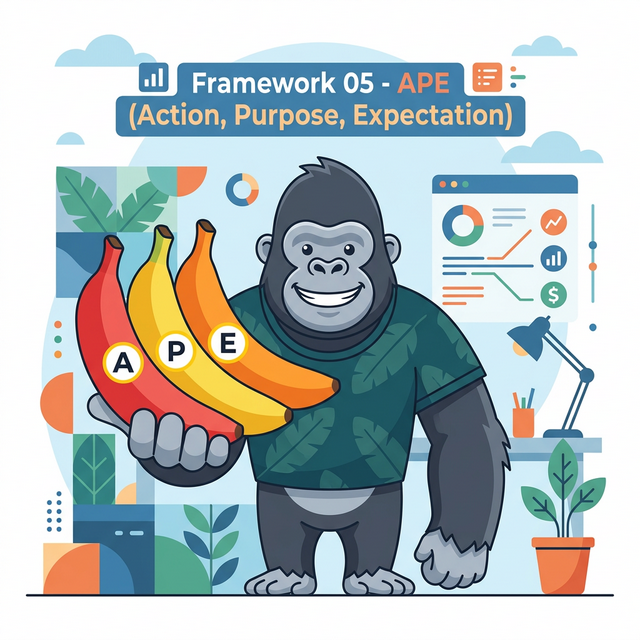
5. APE Framework — Action · Purpose · Expectation
Best for: Social media posts, emails, quick content, and single-output tasks
The fastest clean framework for everyday prompts. Three parts, one sentence. Adding PURPOSE is the secret weapon — most people skip it, but when AI knows WHY, it picks the right tone, angle, and depth automatically.
The 3 Components
- Action → What you want AI to do
- Purpose → Why you're doing it
- Expectation → What the output should look like
Real Example
Action: "Write a LinkedIn post" Purpose: "To position me as a thought leader in digital marketing" Expectation: "300 words, conversational tone, ends with a question to drive comments, no corporate jargon"
Power Upgrade
Add your audience to the PURPOSE: "Purpose: to convince busy moms aged 30-45 that our product saves them time."
Common Mistake
❌ "Write a LinkedIn post about marketing." ✅ Action + Why + What it should look like
Remember: PURPOSE is the hidden ingredient. Tell AI why you need it — and it chooses the right approach automatically.
6. CARE Framework — Context · Action · Result · Example
Best for: Brand content, ad copy, social posts, and anything where tone and style matter
The full-context content framework. The EXAMPLE component is the secret weapon — when AI sees a model to follow, output quality jumps immediately. It stops guessing your style and matches it.
The 4 Components
- Context → The situation or background
- Action → What you need AI to do
- Result → What outcome you want
- Example → A real sample to model after
Real Example
Context: "We are launching a new sustainable clothing line targeting Gen Z." Action: "Write an Instagram caption for our launch post." Result: "We want 100+ comments and shares. Tone: bold, eco-conscious, exciting." Example: "Model it after Patagonia's tone — short, punchy, values-driven."
Power Upgrade
Give 2–3 examples instead of one: "Here are 3 posts I love. Match this energy."
Common Mistake
❌ Skipping the EXAMPLE section entirely ✅ Always give AI something to model after
Remember: One good example is worth 100 words of description. Show, don't just tell.
7. COAST Framework — Context · Objective · Action · Scenario · Task
Best for: Email campaigns, marketing strategies, project planning, and complex multi-part tasks
The most complete conversation setup framework. COAST gives AI the full picture BEFORE it answers — no assumptions, no guesswork. Like briefing a human team member properly.
The 5 Components
- Context → Set the background / the stage
- Objective → Describe the main goal
- Action → Explain what needs to happen
- Scenario → Describe the specific situation
- Task → Name the exact deliverable
Real Example
Context: "I run a small online coaching business with 500 email subscribers." Objective: "Increase monthly revenue by 30% in the next 60 days." Action: "Create a promotional email campaign." Scenario: "We are launching a new $97 online course on personal finance basics." Task: "Write a 5-email launch sequence — teaser, announcement, value, urgency, and last-chance emails."
Power Upgrade
Add constraints to your TASK: "Each email under 200 words. No discount offered. Urgency through scarcity, not price."
Common Mistake
❌ Jumping straight to TASK without context ✅ Take 2 minutes to fill all 5 parts — the output will be 10x better
Remember: AI can only work with what you give it. COAST gives it everything.
8. ICIO Framework — Instruction · Context · Input Data · Output
Best for: Data analysis, summarizing, processing documents, and editing existing content
The precision framework. ICIO forces you to separate WHAT TO DO from WHAT TO WORK WITH. This removes ambiguity and produces clean, specific outputs every time.
The 4 Components
- Instruction → The exact task to perform
- Context → Background information to guide it
- Input Data → The raw material to work with
- Output → The format you want back
Real Example
Instruction: "Summarize this customer feedback and identify the top 3 complaints." Context: "These are reviews from our app users aged 25–40. We are preparing a product improvement report." Input Data: [paste your raw reviews / data here] Output: "Return as a numbered list. 3 main complaint categories, each with 2–3 supporting quotes."
Power Upgrade
Be extremely specific in OUTPUT format: "Return as a table with 3 columns: Issue | Frequency | Suggested Fix."
Common Mistake
❌ Mixing your instruction and context together ✅ Keep each section separate and clean
Remember: Garbage in = garbage out. ICIO makes sure only clean, structured input goes in.
9. RISE Framework — Role · Input · Steps · Expectation
Best for: Content strategy, business growth plans, product launches, and long-term multi-step projects
The deep strategy framework. RISE combines expert identity (ROLE) with all available resources (INPUT) and forces a structured plan (STEPS) aimed at a specific target (EXPECTATION).
The 4 Components
- Role → Who should AI be?
- Input → What information do you have?
- Steps → Ask for a step-by-step breakdown
- Expectation → What does the final result look like?
Real Example
Role: "Act as a senior content strategist with 10 years of experience growing brand audiences." Input: "I have audience data: aged 28–40, interested in personal finance, mostly on Instagram and Facebook." Steps: "Give me a detailed 30-day content strategy plan with daily post topics, format types, and posting times." Expectation: "Grow my blog monthly traffic by 40% and increase email subscribers by 500."
Power Upgrade
Give AI your constraints in the INPUT section: "I only have 2 hours per day and a $200/month budget."
Common Mistake
❌ Skipping STEPS — AI gives a vague overview ✅ Explicitly ask for "step-by-step" with timeframes and specifics
Remember: RISE is your strategic planning partner. The more you put in — the more detailed the plan you get out.
10. TRACE Framework — Task · Request · Action · Context · Example
Best for: High-stakes content, client work, campaigns, and when quality matters more than speed
The most complete single-prompt framework. TRACE removes every possible way AI can misunderstand you. Use it when you want the best possible output the first time — no back-and-forth.
The 5 Components
- Task → Define the specific task clearly
- Request → Describe exactly what you're asking
- Action → Specify the operations needed
- Context → Provide background and situation
- Example → Show a sample of what you want
Real Example
Task: "Write a Facebook post for my brand." Request: "The post should be motivational and drive comments and shares." Action: "Write in an engaging conversational tone. Include a hook, 3 value points, and end with a question." Context: "My brand is about financial freedom for young adults aged 22–35." Example: "Here is a post I loved: 'Nobody taught us this in school...' Match this energy and structure."
Power Upgrade
At the end, add: "Give me 3 variations." — you get options to choose from instead of editing one.
Common Mistake
❌ Using TRACE for simple tasks — it's overkill ✅ Save it for complex or important outputs
Remember: More effort in the prompt = less editing of the output. TRACE is the gold standard.
11. CRISPE Framework — Capacity & Role · Insight · Statement · Personality · Experiment
Best for: Brand content at scale, A/B testing styles, and when tone and voice really matter
The roleplay and multi-version framework. CRISPE doesn't just assign a role — it BUILDS the full persona. Adding PERSONALITY means AI stops sounding robotic. EXPERIMENT means you always get options.
The 5 Components
- Capacity & Role → What expert should AI become?
- Insight → What background and context does it need?
- Statement → What exactly do you want it to do?
- Personality → What tone, voice, and style?
- Experiment → Ask for multiple versions
Real Example
Capacity & Role: "You are a world-class copywriter who specializes in viral social media content." Insight: "My audience is entrepreneurs aged 25–40 who want financial freedom. They respond to bold, no-fluff content." Statement: "Write a Facebook post that gets high shares and saves." Personality: "Confident, direct, slightly provocative. Like Gary Vee meets Alex Hormozi." Experiment: "Give me 3 different versions — one story-based, one list-based, one bold one-liner hook style."
Power Upgrade
Name a real expert as the voice model: "Write like Seth Godin — short, philosophical, and thought-provoking."
Common Mistake
❌ Skipping PERSONALITY — AI defaults to bland ✅ Always define the voice and style clearly
Remember: CRISPE gives AI a full identity, not just a job title. The result sounds human.
12. BROKE Framework — Background · Role · Objectives · Key Result · Evolve
Best for: Full marketing campaigns, business strategy documents, long-form projects, and anything you'll revisit
The big project framework. Most frameworks are one-shot. BROKE is a loop. The EVOLVE step means you never accept a bad answer — you systematically improve it until it's perfect.
The 5 Components
- Background → Set the full scene for AI
- Role → Who should AI be?
- Objectives → What do you want to achieve?
- Key Result → What does success look like in measurable terms?
- Evolve → Improve the answer in 3 ways:
- Improve Input → Fix Background / Objectives / Key Result
- Improve Answer → Correct mistakes in follow-up chat
- Regenerate → Same prompt, generate again, pick the best
Real Example
Background: "We are a D2C skincare brand targeting women aged 28–45. We have 10K Instagram followers and $1,500/month ad budget." Role: "Act as a performance marketing expert with e-commerce experience." Objectives: "Launch our new moisturiser and drive online sales." Key Result: "Generate 200 sales in the first 30 days at a max $7.50 cost per acquisition." Evolve: "The budget is actually $3K — revise the plan" / "Point 3 is too generic — make it more specific to Meta Ads."
Power Upgrade
Use all 3 EVOLVE methods in sequence: Regenerate first → pick best → improve input → correct specifics in chat.
Common Mistake
❌ Using BROKE once and stopping ✅ The real power is in the EVOLVE loop — keep improving until it's perfect
Remember: BROKE isn't a one-time prompt. It's a system. Great results come from iteration, not perfection on the first try.
Quick Reference: All 12 Frameworks at a Glance
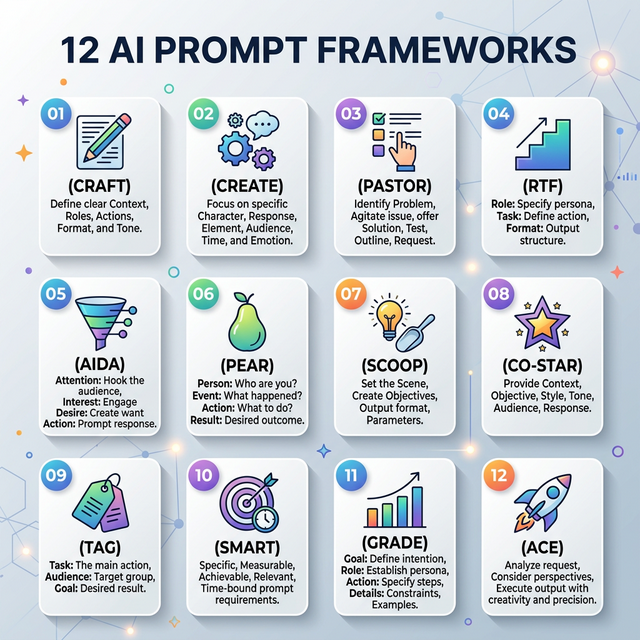
| # | Framework | Components | Best For |
|---|---|---|---|
| 1 | RTF | Role · Task · Format | Quick content, everyday prompts |
| 2 | TAG | Task · Action · Goal | Performance, strategy, measurable outcomes |
| 3 | BAB | Before · After · Bridge | Problem solving, SEO, sales copy |
| 4 | ERA | Expectation · Role · Action | Email sequences, campaign planning |
| 5 | APE | Action · Purpose · Expectation | Social media, quick clean outputs |
| 6 | CARE | Context · Action · Result · Example | Brand content, tone-sensitive work |
| 7 | COAST | Context · Objective · Action · Scenario · Task | Complex multi-part tasks |
| 8 | ICIO | Instruction · Context · Input Data · Output | Data analysis, document processing |
| 9 | RISE | Role · Input · Steps · Expectation | Deep strategy and planning |
| 10 | TRACE | Task · Request · Action · Context · Example | High-stakes, first-time-right outputs |
| 11 | CRISPE | Capacity & Role · Insight · Statement · Personality · Experiment | Role-playing, A/B testing |
| 12 | BROKE | Background · Role · Objectives · Key Result · Evolve | Big projects, iterative refinement |
Pro Tips for Maximum AI Performance
Here are five expert-level strategies that work across all frameworks:
-
Always assign a ROLE first — AI performs dramatically better when it has an expert persona. A "senior content strategist with 10 years of experience" produces radically different output than a generic assistant.
-
Include an EXAMPLE in your prompt — Providing a sample of what you want cuts bad outputs significantly. One good example is worth 100 words of description.
-
Use EXPECTATION to define success — Before you ask AI to do anything, tell it what "good" looks like. Quality standards, metrics, and success criteria transform generic answers into targeted ones.
-
Don't retype — iterate — If the answer is bad, don't start over. Just say "improve point 2" or "try again, shorter." AI learns from correction faster than repetition.
-
Stack frameworks together — Combine elements from different frameworks for elite-level prompts. Use ROLE from RISE + FORMAT from RTF + EXAMPLE from CARE for a killer combo.
How to Choose the Right Framework
Not sure which framework to use? Here's your decision tree:
- Need something fast? → Start with RTF or APE
- Solving a specific problem? → Use BAB
- Planning a campaign? → Go with COAST or RISE
- Tone and brand voice matter? → Choose CARE or CRISPE
- Processing data or documents? → Use ICIO
- High-stakes, must be perfect? → Deploy TRACE
- Big project with iterations? → Start with BROKE
- Working backwards from a goal? → Try ERA or TAG
The best approach? Start with one framework, master it, then move to the next. Don't try to learn all 12 at once. Pick the one closest to your daily work and use it for a week straight.
Frequently Asked Questions
Do these frameworks work with all AI tools?
Yes. These frameworks are tool-agnostic — they work with ChatGPT, Claude, Gemini, Copilot, Perplexity, and any other LLM. The principles of structured prompting apply universally.
Which framework should a beginner start with?
RTF (Role · Task · Format). It's the simplest with only 3 components but delivers a massive improvement over unstructured prompts. Once you're comfortable, move to BAB or APE.
Can I combine multiple frameworks?
Absolutely — and you should. Expert prompt engineers regularly stack elements: take ROLE from RISE, add FORMAT from RTF, include EXAMPLE from CARE. The frameworks are building blocks, not rigid templates.
How long should my prompts be?
Quality over quantity. A well-structured 3-line prompt using RTF will outperform a rambling 500-word unstructured prompt every time. That said, complex tasks (TRACE, BROKE, COAST) naturally require more detail.
Do these frameworks replace prompt engineering?
They ARE prompt engineering — in its most practical, accessible form. Professional prompt engineers use these exact patterns (and variations of them) daily. Frameworks simply codify best practices into repeatable templates.
Conclusion
AI is free. These frameworks are free. The only thing stopping you is using them.
The people winning with AI aren't smarter — they just prompt better. Every framework in this guide represents a proven structure for extracting dramatically better results from any AI tool you use.
Your output is only as good as your input. Give AI structure, and it gives you results. Give it a role, and it thinks smarter. Give it an example, and it nails the format.
Start today. Pick one framework. Use it for everything this week. You'll never go back to one-sentence prompts again.